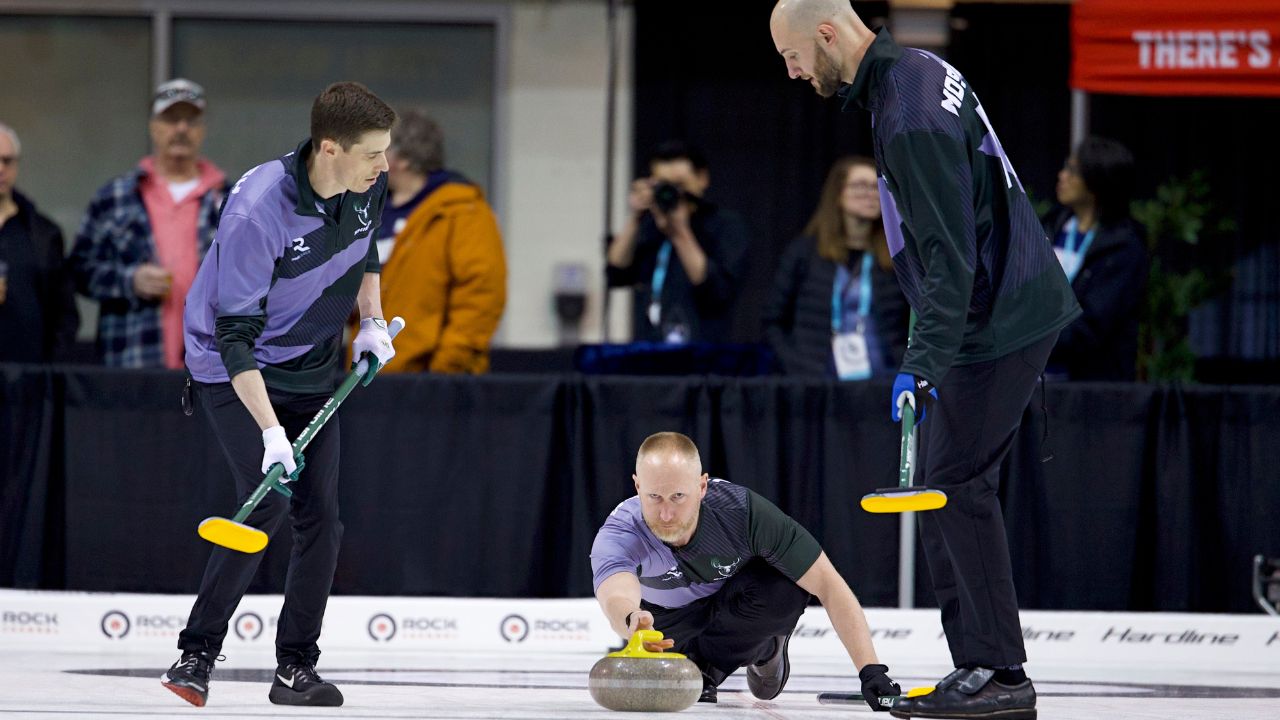
Seeing a Brad Jacobs-led team claim a title wasn’t anything new for curlers and fans, but from the team he did it with, Shield CC, to the trophy they raised, the inaugural Rock League event had no shortage of innovation.
For starters, there was the structure itself, which saw six franchises made up of 10 players from different countries competing on the ice at the same time in men’s fours, women’s fours and mixed doubles, instead of the usual fours of more established events.
That meant that, among other things, everyone got to see Canadian curling legend, and Maple United captain, Rachel Homan team up with current world champion Xenia Schwaller from Switzerland – something that would never happen in a regular curling championship.
There were smaller changes in the preview season, too. Never-before-seen rules were tested by The Curling Group, owners of Rock League and the Grand Slam of Curling, aimed at making the game quicker, with a two-hour broadcast window in mind, and creating more dramatic finishes.
On the whole, curlers came into the week very open-minded about the idea of trying new things to grow the game. But how did they feel once the event wrapped and the trophies were raised?
It’s time to look at the innovations curlers loved and the changes they were less excited about in the first-ever professional curling league.
The enhanced version of the no-tick rule was the biggest talking point for curlers.
Unlike Grand Slams or national events such as the Scotties, Brier, Worlds or Olympics, where curlers can play a tick on any guard not touching the centre line as long as it stays inbounds, no guard was allowed to be touched at Rock League.
Jacobs, now a two-time Olympic champion, viewed the new version of the no-tick rule as a “winner.”
“The no-tick rule, I believe, is a rule that should be put into regular curling immediately,” Jacobs said during a post-game interview.
It was still the same five-rock rule in place for Rock League fours games and three-rock rule in mixed doubles, where curlers couldn’t start hitting until the sixth and fourth stones were thrown,
Jacobs wasn’t the only one who loved that particular rule. The likes of Alina Paetz, Emma Miskew, Kerri Einarson and Bruce Moaut agreed that it was a great way to create more offence.
Even Scotland’s Ross Whyte, who called for his second Craig Waddell to play the tick shot a lot during this year’s world championship (where they took home bronze), liked the rule.
“We love playing that one (the tick shot), but this week not being able to play it, it puts more stones in play. It’s a bit more exciting for the fans I think,” Whyte said. “So, I definitely don’t think that’s a bad one if it was to go forward (into world curling events).”
Another rule that met with popular approval was the chance to earn two points for covering the pin hole in the final end.
“It definitely takes a little bit of an adjustment to the seven ends and the pin rule, but it keeps the game alive and it’s very fast and it’s fun,” Sweden’s Anna Hasselborg, the 2026 Olympic gold medalist, said. “It’s definitely for the fans, for sure.”
The lone dissenting voice was Paetz, who felt the pin was worth “a little too much,” and over the course of the week, I found it was common for one curler to be rubbed wrong by a rule that was otherwise appreciated.
Jacobs still wasn’t the biggest fan of the one-blank rule that was first introduced at Grand Slams this season, where curlers can only use a single blank per game and any more results in a loss of hammer, but thought it worked fine in the Rock League format. Miskew didn’t like flipping a coin for hammer.
“I think we’re already practising out there, it’s really easy just to throw in a draw for hammer and earn it,” Miskew said. “Especially with seven ends, hammer is so crucial because you get four hammers to the other team’s three.”
But also, of the 12 curlers I spoke with half of them, and even Typhoon Curling Club’s general manager J.D. Lind, were on board with all the changes.
“I’ve liked all the rules so far. Honestly, I think the no-tick is an easy one. We already play a version of the no-tick, but I think this makes it even more conducive to more points and more play,” Lind said during a post-game interview.
“The two points for the pin has definitely added another layer,” Lind continued, “and I think a lot of these skips are so good that it’s nice to challenge them with some new rules and get them thinking outside the box.”
However, Einarson and a couple of others believe the new rules shouldn’t be put into regular curling events, such as the Scotties, worlds or Olympics.
“No, I don’t think so,” Einarson said. “It’s tradition, right? Like you want to keep curling when you’re playing at a national or world level.”