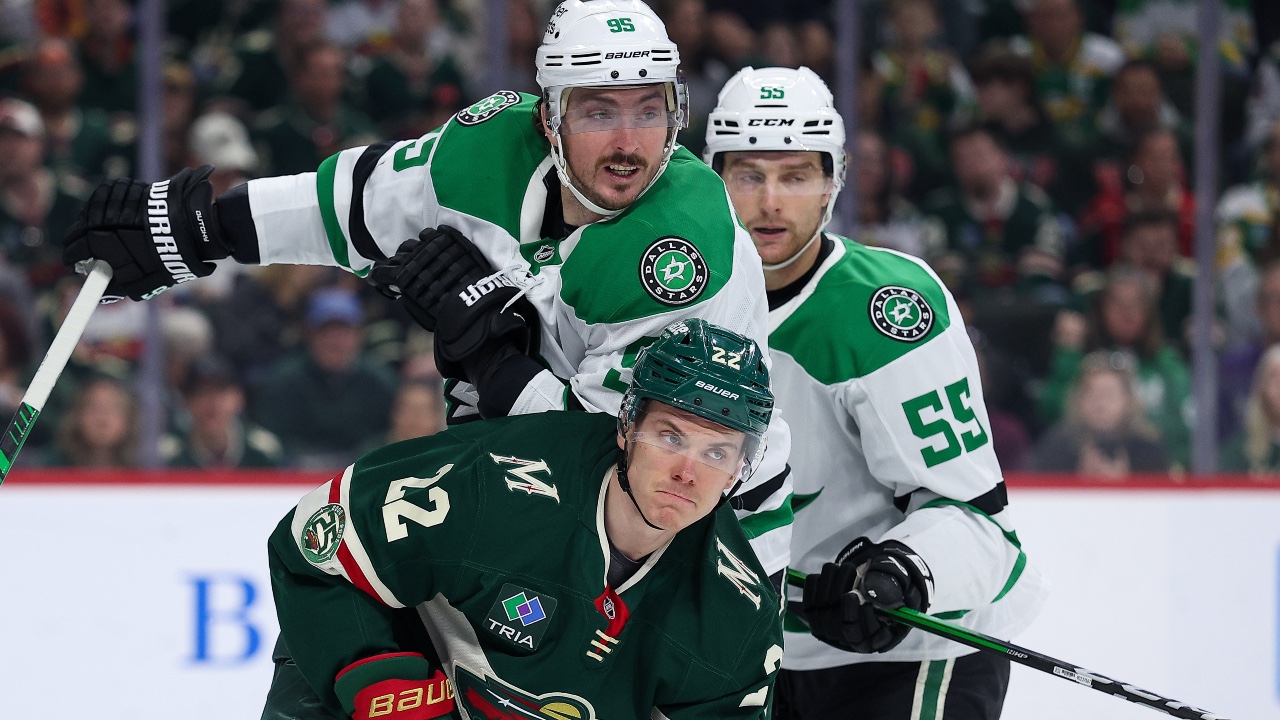
Among the many takeaways from last week’s final regular-season showdown between the Dallas Stars and Minnesota Wild, a 60-minute first-round series preview with home-ice advantage on the line, the biggest was this:
Yeah, we’ll take seven of those, please.
The Stars and Wild have been on a collision course for a first-round bout for most of the 2025-26 campaign. As the Colorado Avalanche built up the best record in the Central — undoubtedly the NHL’s Group of Death this year — they left their foes in Dallas and Minnesota to battle it out amongst themselves. And what a battle it will be.
In one corner, we have a squad newly free from its self-imposed salary cap handcuffs and ready to declare — through the historic signing of top winger Kirill Kaprizov in September, then the pre-Christmas blockbuster for Quinn Hughes less than three months later — that they’re a Cup contender that’s here to stay. Previous playoff berths haven’t had much staying power, the club unable to advance beyond Round 1 in seven attempts since their last trip to Round 2 in 2015.
In the other corner is a team that’s been to three straight Western Conference Finals — and suffered three straight defeats. The 2020 Stanley Cup runners-up are purpose-built to hoist the Cup, but it won’t be an easy path for Dallas.
There’s no shortage of elite talent in this matchup, with four of the league’s top 10 goal-scorers — including three 45-goal-scorers in Minnesota’s Kaprizov and Dallas’ Jason Robertson and Wyatt Johnston — going head-to-head. But it’s not just about the dynamic duos up front. This series also boasts some of the finest blue liners in the league, headlined by Hughes and Miro Heiskanen — two perennial Norris Trophy candidates who can set the pace from the back end. Special teams are a strength for both sides, as is goaltending. In fact, you’d be hard-pressed to find two rosters as evenly matched as these.
The Stars and Wild have twice gone head-to-head in the post-season, matching up in the first round in 2016 and 2023, with the Stars winning both series in six games.
This time around, both teams appear capable of long post-season runs… if only they can emerge from their division, that is.
Here’s what you need to know about this first-round series that has all the makings of a seven-game classic.
Dallas: 2-1-1
Minnesota: 2-2
Stars X-Factor: Jason Robertson
After being injured in the regular-season finale last year and missing Round 1 of the Stars’ playoff run, it took a little time for Robertson to fully get up to speed upon his return. A hot streak of four goals in three games against Edmonton wasn’t enough to propel the banged-up Stars past the Oilers in the Western Conference Final, but it certainly left us wondering how the top forward might’ve fared with a little more runway. Playoff “what ifs” are starting to follow Robertson, whose regular-season scoring pace of more than a point per game tends to drop in the post-season.
This year, expectations are different. Robertson led Dallas’s deep offence in regular-season points, with 96, while sharing the team lead in goals with Johnston (45). His production had him widely projected to make the U.S. Olympic roster, but Wild and Team USA general manager Bill Guerin left him off. A nicely-timed revenge tour would serve the winger well, considering it’s also a contract year for the pending RFA who’s just one year away from unrestricted free agency.
All eyes will be on Robertson and Johnston in Dallas, with comparisons to Minnesota’s own dynamic duo of Kaprizov and Matt Boldy expected to be a major talking point throughout the series.
Adding to the importance of Robertson’s role is the fact Dallas enters the post-season with injury questions yet again. Roope Hintz, sidelined since early March with a lower-body injury, will miss at least the first two games of Round 1.
Wild X-Factor: Quinn Hughes
As if the signing of Kaprizov to an historic extension in September didn’t already send a loud-and-clear message about how serious the Wild are about icing a winning roster, the acquisition of Hughes left zero doubt.
Hughes has been a resounding success since his first game in Minnesota, and if the Wild are to finally break through the first round, the Norris candidate will figure front-and-centre. Minnesota is full of elite playmakers up and down the roster, but a player like Hughes has the power to elevate all aspects of a game — and a series. In two playoff runs with Vancouver, Hughes put up 26 points in 30 games. He’s the kind of player who’s built for the post-season, from logging marathon minutes (his 27:44 per game is a full three minutes more than the next-highest in time-on-ice) to starring on special teams and everything in between.
In a Central Division filled with elite talent on the blue line, the Wild’s decision to go out and get one for themselves might just prove to be the difference if they’re to finally make a real playoff run.
ADVANCED STATS
(5-on-5 totals from Natural Stat Trick)
1. Is Oettinger up to the task?
When he’s hot, Jake Oettinger is one of the top goalies in the league. And while his 35 wins on the season ranks him third league-wide, his save percentage doesn’t exactly match. For the first time in his career, Oettinger finished a regular season below .900 — albeit, just barely. It’s hard to know what to make of his .899 save rate on the season, which bumps up to .911 in even strength and down to .844 versus the power play.
At face value, we see a mark that’s below his usual output. But zoom in, and we see a netminder who fared well against Minnesota this year. Among goalies who started at least three games against the Wild, Oettinger ranked first in both save percentage (.915) and goals-against average (2.73). His numbers took a hit in their last meeting, which saw him allow four goals on 31 shots, but he still got the win. He knows this team well.
The 27-year-old enters the post-season on a hot streak of five straight victories, his save percentage in those wins perfect twice and below .900 in the others. He was streaky last post-season, especially against Edmonton in the Western Conference Final, which ended on a sour note when he was pulled less than eight minutes into the game following two goals on two shots. If he can find a middle ground against Minnesota, the Stars should have no concerns in the crease.
2. After three straight trips to the Western Conference Final with Peter DeBoer, can Glen Gulutzan get them over the hump?
Last year’s playoff run ended in heartbreak for the third straight time, but also some controversy stemming from the way then-head coach Pete DeBoer pulled Oettinger early in Dallas’ must-win Game 5. DeBoer was fired shortly after the series, and while the goalie controversy wasn’t cited as a reason, an overall desire for a fresh voice was.
GM Jim Nill found that fresh voice in Glen Gulutzan, a second-time Stars coach whose first stint with Dallas 13 years ago lasted two seasons and served up plenty of lessons.
While most of this roster remains the same as last year’s, we’re about to find out if Gulutzan can be the difference at the helm.
3. The injury bug strikes again
One year ago, injuries were the biggest story for the Stars as they embarked on their third straight run to the Western Conference Final. They’ll have to overcome the injury bug once again if they’re to go even further this time.
While things aren’t as dire as one year ago, when Robertson was injured on the final day of the regular season, there’s reason for concern when it comes to the status of Hintz and Heiskanen. Hintz, who suffered a lower-body injury against Colorado in early March, will miss at least the first two games. Heiskanen missed the final few games of the season but is expected to be ready for Game 1. The Stars know all too well what it’s like to be without their star puck-moving rearguard and against a Minnesota squad as deep as the one they’re about to face, they cannot afford to experience that again.
1. Which goalie gets the Game 1 nod?
Between Filip Gustavsson (28-15-6, 2.69 GAA, .904 SV% in 49 starts) and Jesper Wallstedt (18-9-6, 2.61 GAA, .916 SV% in 33 starts), the Wild posted the league’s second-highest team save percentage (.903) in the regular season. One of their greatest strengths through 82 games now becomes one of the biggest storylines ahead of game No. 83 — and during a pre-travel practice earlier this week, head coach John Hynes didn’t tip his hand about who he’ll tab to open the post-season.
The most likely scenario is that Gustavsson starts the series. The 27-year-old was the 1A option in the tandem throughout the regular season, and has had strong post-season showings. In 11 playoff starts, all with Minnesota, Gustavsson posted a solid 2.53 GAA and .917 SV%. Wallstedt, a rookie, has yet to appear in a playoff game. But while Gustavsson has the edge when it comes to experience, momentum may side with Wallstedt. He’s allowed more than two goals just twice in 10 starts since returning from the NHL’s Olympic break (where he suited up alongside Gustavsson for Team Sweden). Gustavsson, meanwhile, has put up uncharacteristic numbers down the stretch. He was playing some of his best hockey after returning home from Milan, but in the past month has posted save percentages below .900 nine times — including his final three starts of the regular season.
2. Take it away, Kaprizov
Hughes is our X-Factor, but Kaprizov holds the keys when it comes to our excitement about this series. We saw last year just how effectively he can grab hold of a playoff game. Against Vegas in the first round last spring, Kaprizov potted five goals and nine points in six games. That his campaign was cut short by the Golden Knights’ claiming of the series felt like a loss for hockey fans everywhere, eager to see him continue to heat up.
While Kaprizov is far from the only offensive superstar in this series, he’s the biggest offensive driver out there. He’s also undoubtedly the highest paid, once his historic extension is on the books this summer. In the meantime, he’s got a prime opportunity to show everyone why he’s worth every penny of that new deal as he ushers the Wild into their next chapter of contention.
3. Can Minnesota power-play its way through Dallas?
When you have two teams as evenly matched as the Stars and Wild, special teams could be all the difference. But even those are nearly identical: Dallas and Minnesota rank second and third, respectively, in power play percentage this season, with penalty-kill numbers also not offering up much difference.
The addition of Hughes bodes well for Minnesota’s ability to harness some PP magic in the post-season. We’ve already seen just that, with the defender helping raise the club’s success rate up to 28 per cent from Jan. 1 onwards.
Against Dallas this season, Minnesota’s power play has had a success rate of 35.7 per cent, compared to the Stars’ 44.4 per cent against the Wild. Considering how rough things got in these clubs’ final regular-season showdown, and the mutual dislike already long brewing between these franchises, we could see the series won or lost on the power of the man advantage.