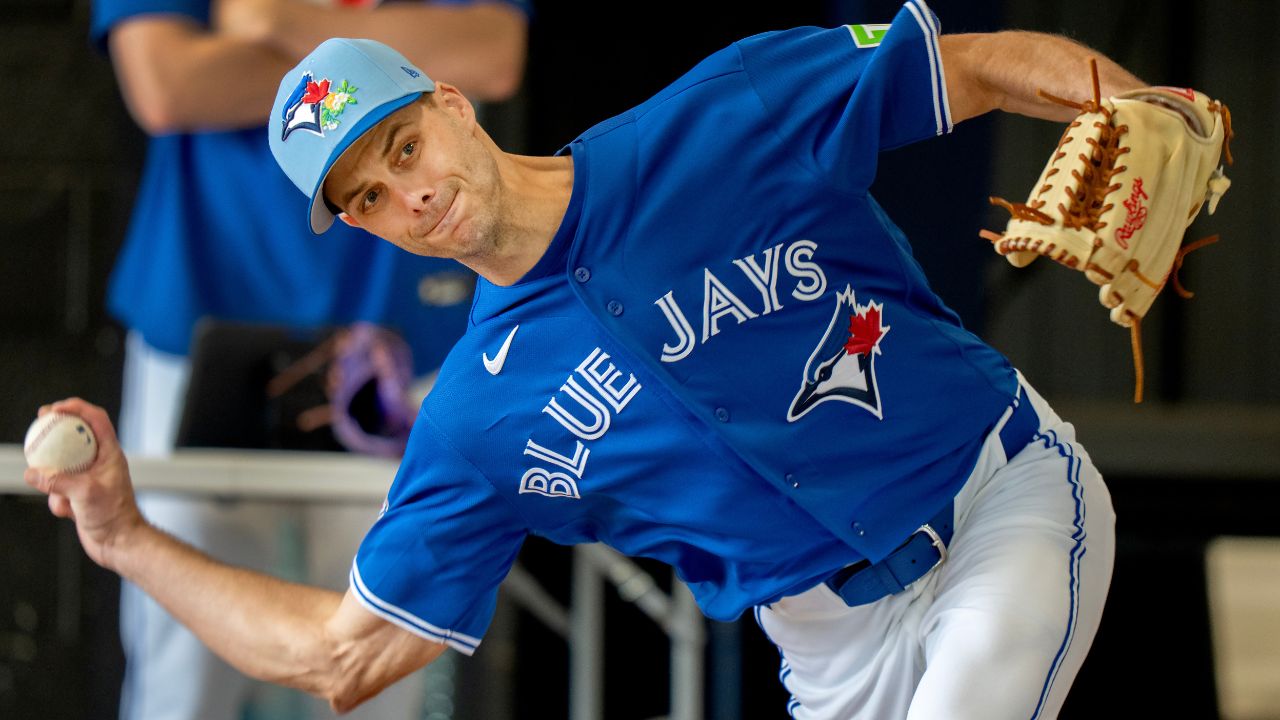
TORONTO — Managing his Toronto Blue Jays with a slew of star players on the injured list, including some key pitching arms, John Schneider is sitting in his office hours before a game in which leadoff man George Springer will break his big toe, thinking about how comforting it is to have a dependable reliever like Tyler Rogers in the bullpen.
“Whoa, where do I begin?” Schneider says of the right-handed submarine reliever Toronto signed in the off-season. “I think you just know what you’re going to get out of Ty.”
Rogers is a rare welcome development for the World Series finalists, who‘ve gone 6-9 to open the season and find themselves waiting for players to get healthy and return to the lineup. At far-from-rosy times like these, the three-year, $37-million contract Toronto signed with Rogers in December is looking better and better, since he’s made a career of providing comfort and reliability.
To date, Rogers and Lazaro Estrada, the bulk reliever who’s appeared in just one game, are the only arms on Toronto’s roster who’ve yet to give up a run this season. In 7.2 innings of work, Rogers has relinquished five hits and struck out as many. It’s what the Blue Jays no doubt hoped they were getting from the reliever who last season ranked first in walk rate and strike rate among qualified pitchers across MLB, and did so with the lowest release point in the big leagues, measured at 1.3 feet from the ground.
-
MLB on Sportsnet
Watch the Toronto Blue Jays, Blue Jays Central pre-game, marquee MLB matchups, Jays in 30, original documentaries, the wild card, divisional series, championship series and entire World Series on Sportsnet and Sportsnet+.
As winding and loopy as that delivery is, so too is Rogers’ indirect path here. He never dreamt of a life in the pros as a kid, and nobody in his family — aside from his twin brother, Taylor, who, in a delightful twist, plays for the Minnesota Twins— ever played baseball. So, when Rogers chose to attend Garden City Community College in Kansas out of high school, it was to follow in well-worn Rogers footsteps.
“I was going to be become a firefighter,” Rogers says. “There’s four generations of firefighters in my family in front of me: My dad, my uncle, grandpa, great-grandpa and great-great grandpa.”
Since Garden City had a fire science program and a baseball team, he thought: Perfect, I can do both of those and come back to Denver and be a firefighter.
“So, that was the plan,” says Rogers.
It got re-routed along with his delivery point during his freshman year when, as Rogers recalls it, Garden City head coach Chris Finnegan said: “You wanna try throwing sidearm or whatever?”
Rogers had pitched up until then with a conventional delivery, but one of his teammates threw submarine style, and Rogers was willing to try it. “I’m like, ‘Sure man, whatever,’” he says. “It wasn’t like an ego hit or anything, because it was just to keep playing baseball for another two years. And it felt natural from the beginning.”
This was back in 2010, and there wasn’t a lot on YouTube when Rogers went looking for low-slinging pitchers to emulate. “A couple old Kent Tekulve videos,” he says of the selection, referencing the former MLB submariner, who’s now 79 years old. “But I think that’s why I like my delivery so much, because it’s mine.”
Over the last 16 years that low delivery has evolved and descended. As Rogers thinks about kids looking for submarine pitchers to emulate finding plenty of video of him, he admits it’s “pretty neat” that they now have his mechanics to study.
“I’ve just got to get my three-year-old to stop throwing sidearm,” Rogers adds, laughing. “He’s like, ‘I throw like you, Dad!’ And I’m like, ‘No, not really…”
While there are a small handful of submariners in MLB now, Rogers is on his own not only in depth of release but results. According to Baseball Savant, he’s in the 97th percentile in Fastball Run Value, which measures the total run impact of a pitcher’s fastballs based on the situation they’re working in. And that’s with a four-seamer that averages 81.4 m.p.h. (in the lowest one per cent league-wide), offering so little heat that Jays closer Jeff Hoffman calls it “batting practice” from any other pitcher.
“They’re not used to seeing it come out of the slot it’s coming out of — it’s really hard to get reps from that angle when they’re taking batting practice,” Hoffman says of one of the challenge hitters face against Rogers, who’s elite at preventing hard hit contact as evidenced by his 97th-percentile hard-hit rate and 96th-percentile ground ball rate among qualified pitchers league-wide. “Nobody’s able to really prepare for it like they’re able to prepare for anybody else who’s got a normal slot.”
Adds fellow reliever Louis Varland: “I don’t know if anybody has even tried to practise it, knowing they have to face Tyler, because the majority of the league throws from overhand, up above, so you probably train for that instead of training for a submarine.”
And it’s not only the release point that’s unfamiliar to batters, the pitches are also “coming in backwards,” as Hoffman describes it.
“He’s using forces of gravity and spin that are the opposite of what we use,” Hoffman says. “His fastball is spinning opposite of what my fastball’s spinning. So, his fastball is basically spinning like an off-speed, right? He’s back-spinning, but from the angle that it comes out of, he’s top-spinning it. … I think for batters that creates a lot of issues in the brain.”
Blue Jays pitchers have joined the long list of Rogers’s teammates who’ve tried to toss sidearm deliveries as low as his. “None of them come close, though,” Rogers says. Varland confirms that, and that rare skill is further confirmation of what helps make Rogers great.
“He makes us more well-rounded, and a better bullpen in general,” Varland says. “You can pitch him at any point in the game, for any hitter. It’s great to have him in there.”
“Our confidence in him getting through an inning is sky-high,” Hoffman adds. “It doesn’t matter what part of the lineup you bring him in for, nobody’s going to be prepared for him. So, it’s kind of like, those are your three free outs, you know? Just throw him in there whenever you feel like it’s going to be the most important part of the game.
“It’s a gamechanger when you’re talking about bridging the gap from starter to whoever is going to come in at the end.”
Hoffman played against Rogers in triple-A and “was always kind of puzzled why” he hadn’t yet cracked an MLB roster.
“His numbers in triple-A and before he got to the big leagues were the same as they are now — like, he just dominated everybody,” Hoffman says. “I’m like, ‘Why isn’t this guy getting a chance?’ I think it was that everybody was kind of scared of it, because not a lot of people were doing it anymore and didn’t really know how the league was going to react to it. But I think when he got his chance, he proved himself.”
Rogers, who made his MLB debut at age 28 with the San Francisco Giants, figures submarine arms are still rare because it’s hard to break into MLB with an unconventional delivery that yields unconventional results. “Looking back, it’s probably hard for a scout to say, ‘Hey, we should draft this guy, he throws mid-80s,’ or whatever the case may be,” he says.
One of the big stories that accompanied his signing in Toronto was that the Blue Jays had pitchers with the lowest and highest release points in the game in Rogers and Trey Yesavage. While the pair have had plenty of conversations, Rogers says they don’t talk about the highs and lows of their respective deliveries. It’s a tired storyline for both.
“I don’t run out of the bullpen thinking, ‘Oh, different look coming in,’” Rogers says. “I just go and do my thing, you know? I believe before Trey got into the big leagues, the biggest difference was Justin Verlander and me. I’ve been here before.”
While Rogers is one of the newest faces in Toronto’s bullpen, teammates say he fits in seamlessly, and he likes to joke around and chat. They call him a range of nicknames, including “Rog,” “Cap” (short for “Captain”) and Varland’s favourite, “Slim Reaper,” thanks to Rogers’s tall and wiry stature and his ability to crush hitters.
“He’s vocal. He’s a leader in the bullpen,” Varland says. “He’s the man.”
“He obviously has a lot of experience in this league, so that can’t be underestimated, what he brings to conversations about baseball,” Hoffman adds.
For Schneider, there haven’t been too many conversations with Rogers so far, because that’s the way both the manager and pitcher like it.
“He’s about as low maintenance as they come, and low-maintenance relievers are my favourite thing in the world,” Schneider says.
Rogers considers what makes him a dependable reliever and, if you ask him, it’s pretty simple.
“I know who I am and I don’t try to get outside of that,” he says, with a shrug. “I just honestly try and be the same guy every day.”