EDMONTON — “We have this little red box of things. Uh… It’s going to sound corny…”
Todd McLellan was taking his 2016-17 Edmonton Oilers into the playoffs for the first time after 10 long years of missing the big dance.
The Decade of Darkness was over in Edmonton. Connor McDavid had arrived, with his first 100-point season. There was this big German kid who’d scored 29 goals. Might turn into a player.
After six years in the NHL, Jordan Eberle would get his first taste of playoff hockey. Milan Lucic, Pat Maroon and Zack Kassian were timing out their circles during warmups, each skating a few feet into the opponent’s zone — one after another, after another — an intimidation routine that set the table for mayhem. Or, at least, the prospect of it.
But McLellan had cut his coaching teeth in Detroit. He knew that the Anaheim Ducks in Round 2 were an entirely different animal than the San Jose Sharks team that Edmonton had defeated in Round 1.
So he went to his “little red box,” sketched on the white board in the Oilers dressing room. And it included exactly what…?
“(Things that) make a difference in winning and losing,” he explained that spring. “It’s not about the reverse on the breakout; it’s not about the faceoff play that you run in the offensive zone.
“It’s about game management. It’s about shift management. It’s about momentum, discipline, commitment level… All those catch-words that coaches use to fill those boxes. And there aren’t very many analytic guys out there that can chart them.”
A near-decade later, it’s the Anaheim Ducks who are on Year 8 of a rebuild and making their first playoff appearance, finally.
The season after they defeated the Oilers in seven games in that 2017 series, the Ducks had 101 points, made the playoffs and lost in Round 1. They haven’t returned since.
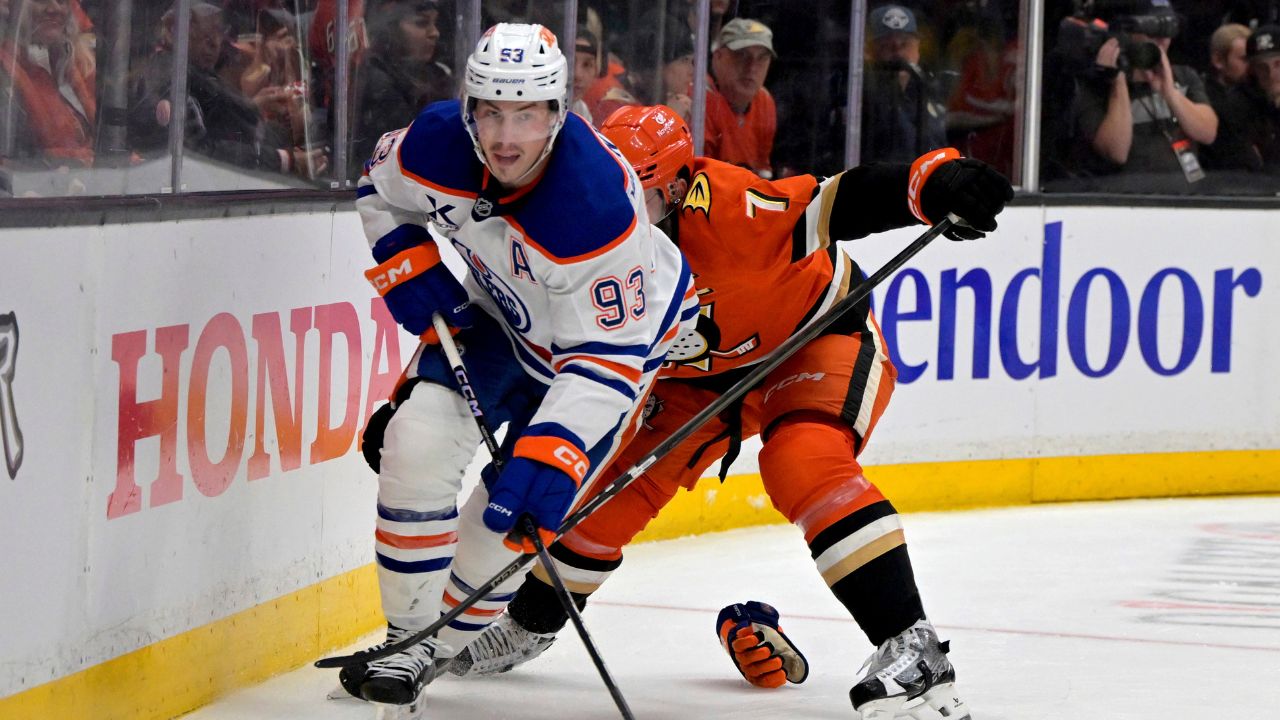
Now, finally, they’re back in and matched up against an Oilers team that has won six rounds in the past two seasons. It’s a veteran-laden, experienced Oilers roster that — just like those 2017 Ducks — has forgotten more playoff lessons than the young Ducks have learned.
“It’ll be a focus of us to be hard on them, not give them anything easy,” explained 1,000-game veteran Ryan Nugent-Hopkins, who broke his own playoff maiden back in ’17. “We know, in general, they just they want to play a fast game. They want to play (run-‘n-gun hockey), and that’s not how we want to play.”
Nugent-Hopkins, 33 and now with two children, remembers looking at that Anaheim roster, with names like Corey Perry, Ryan Getzlaf, Ryan Kesler and John Gibson. Some of them had won a Cup in 2007. They were accomplished playoff vets.
It’s got to be exactly what today’s Ducks see when they peruse Edmonton’s lineup.
“Obviously you know who’s on the other side, and how experienced there they are,” Nugent-Hopkins recalled. “We had a lot of young guys leading the way, and we just played fast and worried about our own game. We also had some big boys who would run around. It was a good first experience, but we’ve come a long way since then, for sure.”
This Ducks team has made a season out of falling behind, then storming back in the third period to grab wins. They’ve been must-watch, not unlike those emerging Oilers were.
But comebacks are hard to find against experienced, playoff-hardened opponents like Edmonton. In the last five years, the Oilers’ 79 playoff games are second in the NHL only to Florida (84).
If you fall behind this team every day, you’re unlikely to come back more than once in a series. Then, you’re not known as the sexy comeback team — you’re just the team that kept falling behind all series.
The Oilers, as contenders tend to do, have steeled their game since the Olympic break.
Connor Ingram is giving them above-average goaltending. Connor Murphy and Darnell Nurse have formed a formidable shutdown pair, two surly six-foot-four shot-blockers and play stoppers who allow the top pair of Mattias Ekholm and Evan Bouchard the freedom to furnish the star forwards with the kinds of pucks that breed offence.
Since March 15, Edmonton is a top-five defensive team in the NHL, allowing 2.47 goals per game. That’s more than a goal ahead of 25th-ranked Anaheim (3.63), as the Ducks have found the art of scoring their way out of their troubles an elusive trait as February turned to March and April.
So Round 1 turns out to be a matchup of the 2026 Oilers versus their younger selves. A firewagon group that has learned the hard way that defence is important against a run-‘n-gun Ducks outfit that is strutting into class for the first time, with a shiny new lunch kit and a fresh haircut.
“Playoff hockey is always tight. We’re comfortable in those games,” promised Connor McDavid. “They’re a very skilled young team that plays with a lot of energy and creates a lot. We’re going to have our hands full and it’s our job to slow them down a little bit.”
McDavid would never say the important part out loud, of course.
The part about how it’s an entirely different game that the Ducks are about to experience. About how, after a decade of playoff hockey, it turns out that the game that wins here isn’t much like the game that got you here at all.
“They’re a young team. It’s their first time in the playoffs and they’ll be excited as they should be,” McDavid said. “They’ve earned their spot and they’ll be excited.
“But we’re excited too.”