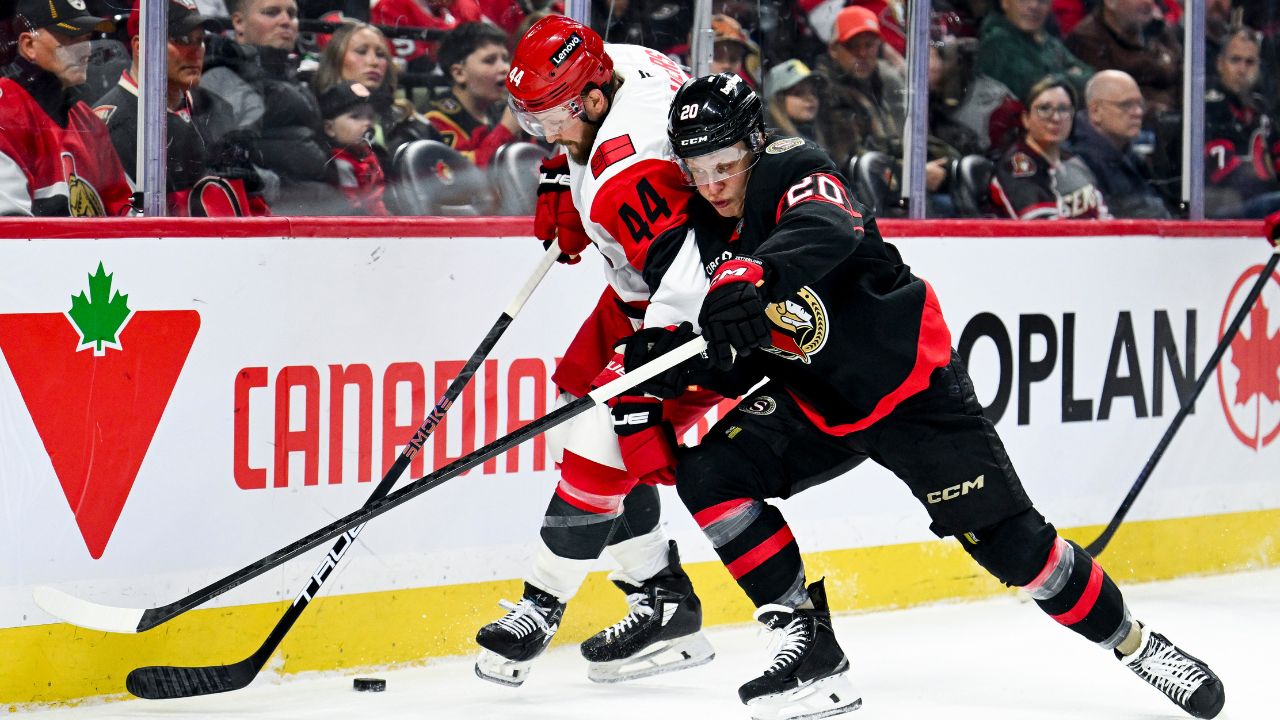
If you were to poll a general collection of NHL fans a week ago, and ask them which team was most capable of pulling off a first-round playoff upset, the most popular answer would probably have been the Ottawa Senators.
If they could just get good goaltending, the Senators were effectively a wagon of a team for many weeks, with underlying numbers that would rival the best in the league. That goaltending did come around just in time to deliver a playoff appearance, but how does Ottawa feel as an upset candidate now that we know who their first-round opponent is?
While Buffalo is a great story, perhaps they play too loosely defensively and would have been ripe to be upset by the Senators. If it were Montreal, perhaps Ottawa was set up with the better four-line, three-defence pairs depth chart to run a smaller, less physical team out of the rink. Tampa Bay came with some injury questions, a star goalie who has had three consecutive “meh” playoff performances, and a missing No. 1 defenceman.
But Carolina? They’re basically the more experienced, more polished version of the Senators.
For as solid an upset bet as Ottawa looked to be (again, if they got the goaltending), the Hurricanes present the toughest potential matchup they could have drawn. The Canes are similar in style, slightly better by the numbers, and have had a relatively solid eight-year run under head coach Rod Brind’Amour, who has gotten them to multiple conference finals. Carolina hasn’t gotten over the hump yet and is in danger of becoming this generation’s San Jose Sharks, but their disappointment tends to come in the later rounds.
Still, this is a highly intriguing matchup, close on paper and similar in the areas of the roster that are concerning.
This will be the first time these two teams have ever met in the Stanley Cup Playoffs, and it’s set up to be one heck of a series. Can Ottawa take last year’s playoff return, first-round elimination, and build off it? Can Carolina make its way through a wide-open Eastern Conference and finally make it to the Stanley Cup Final that’s eluded them?
Here’s a look at our Round 1 preview.
Hurricanes: 1-1-0
Senators: 1-1-0
Hurricanes X-Factor: Bussi, or Andersen… or Kochetkov?
What a strange year it’s been in Carolina’s net, and after 82 games, the picture is murkier than ever. Brandon Bussi began the season as the No. 3, but when an injury befell Pyotr Kochetkov (suspected to be season-ending) and poor play caught up with Frederik Andersen, Bussi was given his shot, and by mid-February, he had run up a 23-3-1 record. He even earned a contract extension mid-way through the season and looked to be taking over as the No. 1.
However, Bussi’s play post-Olympics has cratered to an .865 save percentage, among the worst in the league. Andersen hadn’t been that much better, and, in a shocking development given the earlier indications of his injury, Kochetkov returned to practice with the team, got an AHL stint, and was even lined up to play Carolina’s final regular-season game before he was a late scratch due to a “roster technicality.” He may yet play himself into this equation.
All told, Carolina has a great depth of three goaltenders, but none of the healthy ones had been playing all that well down the stretch, and the other is coming off a major injury. For as strong as Carolina’s underlying numbers are and as much playoff experience as they have, will one of these goaltenders stand up and meet the moment?
Senators X-Factor: Do they have enough offensive finishers?
It’s funny when you compare the Senators and Hurricanes by the numbers to see how similar they are. They are both strong defensively and also create a lot of offence. You’ll see both teams among the best in the league in goals and expected goals in the 2026 portion of the season, as well as among the best in shots against and expected goals against.
But in just about every case, Carolina is just a little bit better than Ottawa. You could easily make the case that the Senators are the mini version of the Hurricanes, structurally strong on defence, and dangerous attacking on offence.
Over the years, as Carolina has had continued playoff success, in that they’ve won several rounds, ultimately, they’ve fallen short every time, often because they haven’t had the game breakers to lift them past other tight-checking teams. And that’s what we wonder about this year’s Senators. Tim Stutzle and Drake Batherson were their top two scorers last season, but the two combined for three goals between them in last year’s six-game series loss to Toronto. Brady Tkachuk is the spiritual leader of the club and managed 22 goals in 60 games, but that total was far below his “expected” goals of 31.03. Dylan Cozens, Shane Pinto and Fabian Zetterlund round out Ottawa’s top six scorers from last season, and those three players also combined for only two playoff goals last spring.
So, against the tough-checking Canes, who can match and exceed what Ottawa throws at it, will the Senators be able to bury the puck enough to get through?
ADVANCED STATS
(5-on-5 totals from Natural Stat Trick)
1. Can they keep their streak of first-round series wins going?
This will be Carolina’s eighth playoff appearance in a row, all under head coach Rod Brind’Amour, and they’ve gotten past the first round in each of the previous seven. They’ve made it to three of the past seven Eastern Conference finals, and so have been just on the verge of making it into the Stanley Cup Final. However, in reality, every time they’ve reached the third round, they’ve been blown away. In those three appearances, Carolina has won just a single game.
Of the 10 series the Hurricanes have won under Brind’Amour, eight came against Metropolitan Division teams, and just one was against an Atlantic team (the other was against Nashville in the re-aligned pandemic season). This year, they’re playing an Atlantic team right out of the gate, and despite finishing first in the conference, Carolina is not drawing a soft opponent. This will be their biggest test yet in the opening round.
2. Will enough offensive difference makers step up this year?
We labelled this as the X-Factor for Ottawa, and for Carolina, it’s just a yearly narrative now that tends to catch up to them. Can it be different this time? Usually, Carolina’s lack of a game breaker — a true superstar — nips them in the later rounds, but given how similar this opponent is to their own game, the Canes might be tested in this area of relative weakness earlier in this year’s playoffs.
One addition to this year’s team has a chance to make a huge difference. Nikolaj Ehlers was, for years, an underused, very productive player in Winnipeg, and he delivered them five goals in eight post-season games last year. With Carolina, Ehlers set new career-highs in assists and points and was used just about everywhere in the lineup, finally ending up on the third line with two of Carolina’s best checking forwards.
So, Carolina will be looking to the usual players on the top lines — Sebastian Aho, Andrei Svechnikov, Seth Jarvis — to carry the offence, but perhaps having their second-highest point getter on the third line can help with the spread. Yes, Carolina can create offence, but they had the worst shooting percentage (re: finishing) among all Eastern Conference playoff teams.
3. Will they be able to put up with, and fight through, Ottawa’s physical game?
The Senators had more recorded hits than any other playoff team this season, and so we know they will bring the physicality to Carolina. We know Tkachuk won’t be shy to lean into this style of game, and neither will Nick Cousins or Dylan Cozens, and Fabian Zetterlund isn’t afraid to get his body involved. The Senators will be looking to wear down Carolina, and while the Hurricanes have toppled “physical” teams in the past, again, this opponent is also the most skilled they’ve seen in the first round, so the combination will be unlike anything the Canes have gotten used to playing against so early in the tournament.
1. Can Linus Ullmark deliver an upset?
The Senators spent a lot of money to bring in Vezina Trophy winner Ullmark to their team last year with the expectation he’d settle their crease and be the final piece of an emerging roster. In Year 1, he delivered on that promise in the regular season. And while Year 2 was certainly more bumpy — the goaltending was keeping Ottawa out of the playoffs for the longest time — he finished with a .926 save percentage in six April starts. Post-Olympics, Ullmark went 12-4-3 with a .902 SV% and 2.51 GAA, so perhaps he’s coming around at just the right time.
2. Will this be Jake Sanderson’s break out performance to a national audience?
You don’t need to tell Senators fans how great Sanderson is. Every night, Sanderson plays against top competition, leads Ottawa’s blue line in average minutes at even strength, on the power play, and on the penalty kill, and in 67 games played, he posted 54 points. That 0.81 points per game mark ranked 14th among all NHL defencemen.
He and partner Artem Zub have formed one of the best — perhaps underrated — top pairings in the NHL. With Sanderson on the ice at 5-on-5, the Sens control the run of play and earn nearly 57 per cent of all shots taken and outscore the competition by 12 goals. Zub, in fact, was Ottawa’s plus-minus leader this season.
But how aware is the rest of the league, and other teams’ fans, of Sanderson’s capabilities? Against Carolina, Sanderson will play opposite Jaccob Slavin, who was long one of the more underrated defensive defencemen and is now one of the most recognized for what he does well. If Sanderson can tip the scales in Ottawa’s favour when he’s sharing the ice with Slavin, the Senators will be in a great position.
3. The third line’s ability to stall Carolina’s attack
In such a tight series statistically, and against an opponent that on paper has a lot of lines that will attack you in waves, we have to wonder where the Senators could slow down the Hurricanes. And for that, we turn to the third line, specifically the Shane Pinto and Michael Amadio duo.
Pinto scored 20 goals for his third full season in a row, while Amadio was not far behind and put up a career-best 35 points at 29 years of age. But the real strength these two bring to the team is their defensive play, which drew a little attention for Selke consideration this season.
Often challenged in the shutdown role, when Amadio and Pinto shared the ice together at 5-on-5 this season, the Sens outshot opponents 319-266 and outscored them by three, an advantage that might be the difference in this opening-round series.